


Bulova: Beyond Chronography, History, Technology, and the Legacy of Absolute Precision (360 Hz and 262 kHz)
- Cheap watches what a passion!

- Feb 10
- 10 min read
Genesis, Founding, and the Industrial Era (1875-1959)

The Vision of Joseph Bulova and the Birth in New York
The founding of Bulova took place during a period of industrial transition, driven by the vision of Joseph Bulova, an immigrant originally from Bohemia, who arrived in the United States in 1870. Just five years later, in 1875, Bulova, at the age of twenty-four, founded the J. Bulova Company on Maiden Lane, in the heart of New York City. Initially, the business focused on jewelry and watch and clock repair, immediately establishing a link with artisanal quality and precision.
The company's growth was rapid, fueled by the founder's relentless pursuit of perfection, efficiency, and precision. In 1911, the company expanded its production to include table clocks and pocket watches. The real breakthrough in serial production came in 1912, when Joseph Bulova opened a manufacturing plant in Biel (Bienne), Switzerland, specifically dedicated to the large-scale production of quality watches.
This geographical and strategic duality, between the commercial and design headquarters in New York and the manufacturing base in Switzerland, has been a defining characteristic of the brand since its inception, a model that is reflected in the current corporate structure under the Citizen Watch Company. The company was reincorporated as the Bulova Watch Company in 1923, a step that symbolized its definitive shift toward watch production.
The Industrial Footprint and Pre-Electronic Innovation
Joseph Bulova is recognized in the annals of horology for embracing the principles of industrialization. His "American Watchmaking System," implemented at the Bienne factory, allowed for the first time the creation of standardized parts and the use of the assembly line in watchmaking. This dedication to mechanization earned him the reputation as the "Henry Ford of watchmaking," emphasizing that his first major revolution was not intrinsic to the movement, but to the production process. This emphasis on efficiency and tight tolerances for mass production proved crucial decades later when Bulova would dominate the sector with electronic technologies.
In terms of product, Bulova was a pioneer in the wristwatch market, introducing its first complete line of men's wristwatches in 1919. In 1924, the company distinguished itself by marketing the first complete line of women's jeweled wristwatches. Culturally, Bulova cemented its reputation for precision in 1926 with the invention of the radio time signal, which allowed millions of people to synchronize their watches, establishing the brand as a public benchmark for time measurement.

A historical element often recalled in modern collections is the MIL-SHIPS-W-2181 Submersible prototype. In the late 1950s, Bulova was selected to build a watch for the U.S. Navy's Bureau of Ships as an American alternative to elite Swiss divers (like Rolex, Enicar, and Blancpain). Although Bulova submitted three prototypes in 1957, two failed the Navy tests, and the model never entered full production. This technical failure of over sixty years ago has now been transformed into a valuable heritage asset, with modern re-editions celebrating the rarity of the unreleased military prototype.

The Tuning Fork and the Space Revolution: The Accutron Era (1960-1977)
The Accutron Invention and Functioning
Bulova's second and most significant technical revolution was the introduction of the Accutron (Accuracy through Electronic) in 1960. This development was led by the Swiss engineer Max Hetzel, who registered the patent for the tuning fork movement in 1953.

Officially launched on October 10, 1960, the Accutron Spaceview 214 was presented by Bulova president, General Omar N. Bradley, as the world's first completely electronic wristwatch. Its distinguishing feature was the elimination of the traditional mechanical regulating organ, the balance wheel. The Accutron instead used a small tuning fork powered by a transistorized oscillator.
Technical Analysis of Frequency and Precision
The tuning fork, the beating heart of the Accutron, vibrated at a significantly higher frequency than any mechanical movement of the era (which typically operated between 2.5 and 5 Hz). The most common Accutron calibers (214, 218, and 219) vibrated at 360 Hz (cycles per second).
This extremely high frequency guaranteed unprecedented precision for the time: the Accutron maintained time with a maximum deviation of approximately two seconds per day, equivalent to 99.9977% accuracy, setting a new global standard for wristwatch chronometry.
A technical effect directly resulting from the 360 Hz frequency was the continuous, ultra-smooth sweeping seconds hand, which did not jump like in mechanical watches or later quartz watches. Each second was divided into one hundred equal increments, creating a powerful aesthetic and sonic differentiator (the "hum of the tuning fork").
Despite its exceptional precision, the tuning fork had a weakness: its frequency was sensitive to spatial position, potentially varying up to five seconds a day depending on the orientation. This technical limitation was later partially resolved by other companies (like ESA, with the 9162 model at 300 Hz).
The Space Contribution and the End of the Tuning Fork Era
The Accutron was quickly adopted by NASA, which used it for precision instruments and timing devices on 46 space missions. The Accutron's reputation as a "space-age instrument" was solidified when an Accutron clock was placed by Buzz Aldrin on the Moon in the Sea of Tranquility during the Apollo 11 mission. The Accutron Astronaut model was also standard issue for US Air Force pilots.
The golden age of the tuning fork ended due to competition from standard quartz. The introduction of the Seiko Quartz Astron in 1969 and the subsequent mass adoption of standard quartz (with oscillators at 32,768 Hz) offered similar or superior precision at significantly lower production costs. Bulova was forced to release an Accutron collection with quartz movements in 1976 and definitively ceased production of the tuning fork movements in 1977, after selling over 5 million pieces.
Today, the Accutron legacy lives on through two channels: historical re-editions and the Accutron brand relaunch in 2020 with a completely new proprietary technology: the electrostatic movement. This new caliber, while not using a tuning fork, aims to restore the Accutron brand's prestige for innovation, utilizing an intricate system of motors and turbines to generate power.
The Modern Legacy of Precision: Precisionist and Curv (Post-2008)
The Acquisition by Citizen and the New Challenge
Bulova's modern history is inextricably linked to the acquisition by the Citizen Watch Company Group in 2008. Citizen, a giant known for its electronic innovations like Eco-Drive, aimed to leverage Bulova's American heritage and reputation for precision.
After briefly dominating the market with the Accutron and suffering the quartz crisis, Bulova needed a new distinctive technological identity. Under Citizen's guidance, the goal was set: to create "the world's most accurate quartz watch with a continuously sweeping seconds hand."
The Precisionist (UHF) Technology at 262 kHz
The answer was the Precisionist technology, launched in 2010. This movement repositions Bulova in the High Precision Quartz (HPQ) segment, challenging the limits of conventional quartz chronometry.
Innovation and Frequency: Precisionist technology uses a proprietary oscillator that vibrates at 262,144 vibrations per second (262 kHz}). This frequency is precisely eight times higher than the 32,768 Hz frequency used in standard quartz. To achieve such stability, Bulova modified the crystal's conformation, using a three-pronged structure instead of the standard two prongs.
Performance and Advantages: The combined effect of this Ultra High Frequency (UHF) and the three-pronged crystal gives the Precisionist exceptional accuracy, limiting the maximum deviation to just +- 10 seconds per year. Furthermore, the higher frequency makes the movement significantly more resistant to external influences that disrupt conventional quartz stability, such as physical shocks and temperature changes.



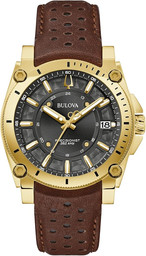


The introduction of UHF technology is not just a pursuit of numerical precision; it is a strategic connection to Bulova's historical legacy. The 262 kHz vibration allows the seconds hand to move in a sweeping, continuous, and fluid manner, just as it did in the original Accutron. This aesthetic element is crucial for the perception of quality and luxury, differentiating the Precisionist from the ticking movement typical of common quartz.
Other Bulova 262 kHz models available on Amazon USA





The Curved Movement (Curv Collection)
In addition to pure frequency precision, Bulova has continued to pursue primacy in structural engineering. The Curv collection, introduced as the world's first chronograph to feature an entirely curved movement, is evidence of this.


The challenge of curving the chronograph movement is immense, as the various components, plates, and bridges can no longer reside on the same plane, requiring complex proprietary development.This curved chronograph caliber is housed in ergonomic cases (often in materials like steel, titanium, or forged carbon) and uses the high-performance UHF movement at 262 kHz, allowing these chronographs to measure intervals as short as 1/1000 of a second. The design is not only aesthetic but functional, precisely following the curvature of the wrist for superior comfort.
The Archive Series: Reimagining and Reworking Icons
The Archive Series represents Bulova's strategy to tap into its deep historical catalog, relaunching iconic models with modern technology (especially UHF and Miyota).
Lunar Pilot Chronograph
The Lunar Pilot is perhaps the most famous model in the Archive Series, stemming from Bulova's partnership with NASA in the 1960s and '70s.
Although the Omega Speedmaster was the official watch supplied by NASA, Apollo 15 mission Commander David Scott brought a customized Bulova chronograph as a reserve. When the crystal of his Speedmaster detached, Scott wore the Bulova on the lunar surface in 1971. Consequently, the Bulova watch became the first, and so far only, privately owned watch worn on the Moon. Its historical significance was underscored by its sale at auction in 2016 for a record-breaking $1.62 million.
The modern re-editions (such as the Special Edition Lunar Pilot Chronograph) replicate the vintage design but integrate the proprietary UHF high-performance quartz movement (262 kHz), ensuring the historical tribute offers contemporary precision, strategically linking the historical icon to the brand's cutting-edge technology.

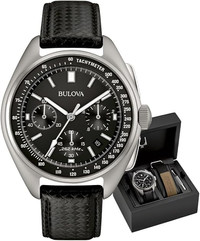


Oceanographer "Devil Diver"
The Oceanographer is Bulova's dive icon. It was nicknamed the "Devil Diver" not for demonological connotations, but for its impressive water resistance of 666 feet (equivalent to 200 meters), a rating that exceeded professional standards of the era and represented a significant technical achievement when watches were the only reliable underwater timing instruments.



Bulova has relaunched historical models like the 1968 "Snorkel" version. The re-editions maintain the distinctive "C-case" (tonneau) shape of the 1970s. Recently, Bulova evolved this line by introducing the Oceanographer GMT (Devil Diver GMT), leveraging privileged access to the Miyota 9075 automatic caliber. This caliber is notable for being a "true GMT" (or flyer GMT), with the hour hand independently adjustable, providing advanced functionality (usually available in higher-end watches) at a competitive price, thanks to vertical integration within the Citizen Group.


Other Relevant Icons
The Archive Series includes other models that demonstrate the diversity of Bulova's heritage:
Computron: Relaunch of the LED digital watch with an inclined display (ideal for reading while driving) that was popular in the 1970s.


MIL-SHIPS-W-2181: The commercial release of the 1957 military prototype, which was never issued to the public.The 2021 re-edition is faithful to the original, including the humidity-sensitive paper strip on the dial, which changes color to indicate a loss of water resistance (200 meters).


Chronograph C and "Parking Meter": Other distinctive chronographs from the 1970s that have been reissued to capitalize on vintage design nostalgia.


Corporate Strategy and Movement Management (Citizen Group)
Corporate Structure and Identity
Since 2008, Bulova has been a key, wholly-owned subsidiary of the Citizen Watch Company Group (which includes Citizen, Frederique Constant, and the Miyota movement supplier)
Despite the Japanese acquisition, Bulova has maintained a deeply rooted American identity, with its corporate headquarters still located in New York City. Citizen uses Bulova as a vehicle for its High Precision Quartz technology (Precisionist) and to capitalize on the brand's incredible American historical heritage (space, architecture, innovation).
Movement Sourcing Analysis
Bulova's movement strategy is complex and reflects its position within a large manufacturing group.
Proprietary Movements (Within the Group):
UHF Quartz (262 kHz): The Precisionist and Curv calibers are proprietary Bulova developments, created by leveraging the R&D capabilities of the Citizen Group (in collaboration with Miyota). These movements represent Bulova's true exclusive technological core
Electrostatic Accutron: Used in the relaunched Accutron brand in 2020, it is a separate technological showcase, also owned by the group, focused on high-end electronic watchmaking.
Third-Party (Strategic) Movements: Bulova uses a differentiated management of mechanical movements to optimize cost, reliability, and market positioning.
Miyota (Citizen Group): Miyota automatic movements are widely used in mechanical collections (such as Aerojet, Oceanographer, and Wilton). Sharing the same parent company guarantees Bulova privileged access to new calibers. A prime example is the use of the Miyota 9075 GMT in the Oceanographer GMT and Classic Wilton GMT lines.This early positioning of a true GMT (or flyer GMT) caliber gives Bulova a significant competitive advantage over other brands in the price segment
Sellita (External Swiss): For some of its automatic ranges, Bulova continues to use third-party Swiss mechanical movements like Sellita. This choice is strategic, aimed at maintaining a premium positioning or obtaining Swiss Made certification for certain lines, balancing internal sourcing (Miyota) with Swiss reliability.
Current Product Lines and Collaborations
Bulova's current collections focus on heritage, proprietary technology, and significant design collaborations:
Core and Technology Collections: In addition to the Precisionist and Curv lines, main collections include Marine Star (dive and sport watches) and Aerojet (classic automatics).
Frank Lloyd Wright Collaboration: A long-standing partnership with the Frank Lloyd Wright Foundation, beginning in the 1990s, translates the architectural principles and iconic geometries of the celebrated American architect into wristwatches and clocks. This collaboration positions Bulova as a brand that unites engineering and artistic design, providing access to exclusive sales channels like museums and historical sites.
Shelby Racer Chronograph: Celebrating Bulova's 150th Anniversary, a limited-edition collaboration with Shelby American was launched. The Shelby Racer chronographs, inspired by the classic 1967 Shelby GT500, use the Precisionist movement, combining Bulova's motorsport heritage (it was the official timekeeper for NASCAR and IndyCar in the '60s and '70s) with its UHF technology. The collection is designated the Racer Chronograph in the core portfolio.
Caravelle: Caravelle, operating since 1962, is an distinct product line "Designed by Bulova" and is primarily known for its retro-cool aesthetic and accessible price point.
Benetton: Bulova also has a history of special collaborations, including with the fashion brand United Colors of Benetton.
Other: Collections also include lines like Crystal (focused on jewelry aesthetics), Sutton, and the limited-edition Joseph Bulova collection.








Conclusions and Final Assessment
Bulova emerges from this analysis as a brand whose identity is defined by its relentless pursuit of precision through frequency innovation. Its history is marked by three great technological epochs: industrial standardization in the early 20th century, the electronic revolution with the Accutron 360 Hz in the 1960s, and the current leadership in Ultra High Frequency quartz with the Precisionist 262 kHz.
Despite its deeply American roots and pride in its space and military history (as demonstrated by the Archive Series), its modern sustainability is entirely dependent on its integration into the Citizen Group ecosystem. This integration allows Bulova to exploit the advantages of verticalization, gaining privileged access to advanced Miyota calibers (like the 9075 GMT) and the resources needed to develop complex proprietary technologies, such as the Curv movement and the 262 kHz UHF.
Bulova's current strategy is a sophisticated balance between nostalgia and avant-garde. The company successfully monetizes its rich historical heritage (through the Archive Series and the re-imagination of icons like the Lunar Pilot, Oceanographer, and MIL-SHIPS) while simultaneously investing in technologies that offer quantifiable precision and perceived luxury (the smooth sweeping seconds hand) that distinguish it from mass-market competition. The obsession with high frequency, which links the Accutron to the Precisionist, provides Bulova with a coherent and powerful narrative in the contemporary watch market. Bulova is not merely a brand with a history, but a continuous technological pioneer whose trajectory is now strategically managed to maximize both heritage and performance.
Visit Bulova Store on Amazon USA: https://amzn.to/49dVurp


Bulova forever!